
Greece
By Christian Elia
Santorini is one of those places of such beauty that it risks being confined to a postcard. Beyond its sunset – which has now become a global brand – lies an island, a community and a history that deserve to be experienced, respected and told.
It was on this very Greek island that the Hearth Aegean Summit, organised by Impact Hub Athens, took place from 23 to 25 October 2026. The event brought together a diverse range of organisations, united by the vision of a journey through social innovation, sustainability and local communities, to share ideas that will transform the Mediterranean into a tangible, shared legacy.
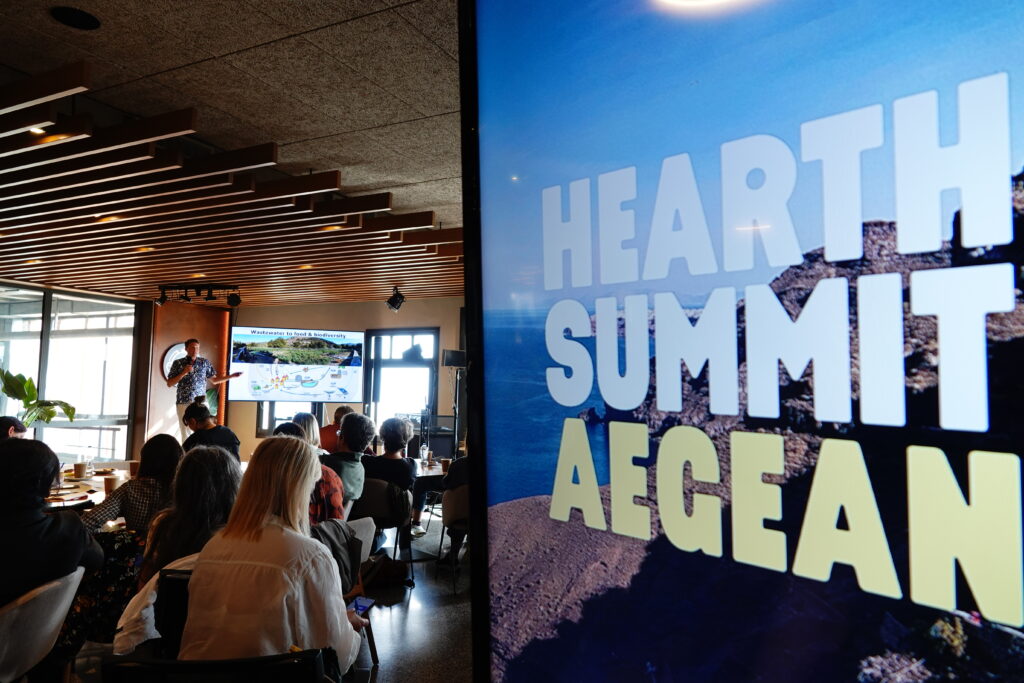
The first two days, facilitated by Fabio Volkmann and Sheila Darmos, saw participants defining their intentions, exploring coastal paths and gaining first-hand experience of initial practical solutions for island waste management; the atmosphere on the final morning was charged with a different kind of energy: pragmatic, urgent and collaborative. Experts in the field illustrated how waste management, water resources, artistic resources and gender issues can serve as lenses through which to analyse and plan for island communities.
On the final day, at the island’s ‘D. Nomikos’ Industrial Tomato Museum, the focus shifted to the presentation of concrete initiatives, such as the Sublime project and its sub-grantees, as well as the Kamalé and Sciatumia calls for proposals. And it was a success within a success not only to discuss how – for Sublime – connecting frontier communities is a way of empowering them and sharing their experiences with everyone, but also to see how the sub-grant mechanism has generated activities that are now capable of standing on their own.

No fewer than twenty-four projects for the future of the Aegean and beyond – many of which involve approaches that can be adapted to areas facing similar challenges, such as the management and optimisation of scarce water resources, depopulation, the impact of tourism, the enhancement of historical and cultural heritage, and sustainable agriculture and viticulture – were able to connect with partners to grow and network with one another.
Nicola describes the methodology used in Mauritius to integrate hotels with local communities; Yasemin is working on transforming tourism from an extractive industry into an educational force; the Vatiki network from the island of Tinos proposes a model of direct synergy between hoteliers and local farmers, whilst Johannes shares the experience of CluBE and the European HUBS4BUILD project, aiming to map those in Greece who wish to adopt circular building materials; Filippos and Lykaon, meanwhile, emphasise the restoration of dry stone walls and abandoned terraces, seeking ways to make their restoration an economically sustainable activity for young people. Then there is Robin, who is spearheading the creation of a bank of traditional, drought-resistant seeds for vegetable gardens without irrigation. Everywhere, there is a clear need to decentralise decision-making and involve local residents in development choices.
Activists, tourism operators, local government representatives, civil society organisations and entrepreneurs: different perspectives, interests that must become shared, networks that can only grow by cross-fertilising one another.
It is time to set out afresh, aware that we have only sown the seeds, with a commitment to turning them into reality.
